Microbiology laboratories require sterile equipment and contamination-free environments to achieve accurate research, testing, and quality control results. One of the most essential laboratory instruments used for sterilization is the Hot Air Oven. It uses dry heat sterilization to eliminate bacteria, fungi, viruses, spores, and other microorganisms from laboratory equipment without the use of moisture.
These ovens are widely used in microbiology laboratories, pharmaceutical companies, hospitals, research institutions, food testing laboratories, and biotechnology industries.
What is a Hot Air Oven?
A hot air oven is a laboratory heating equipment that sterilizes instruments and materials using dry heat. Unlike autoclaves that use steam, hot air ovens circulate heated air uniformly throughout the chamber to destroy microorganisms by oxidation. They are particularly suitable for sterilizing glassware, metal instruments, powders, oils, and moisture-sensitive materials that cannot be sterilized using steam.
Uses of Hot Air Ovens in the Microbiology Industry
Sterilization of Laboratory Glassware
Hot air ovens are commonly used to sterilize glass beakers, flasks, Petri dishes, pipettes, test tubes, measuring cylinders, and glass bottles before microbiological experiments. This ensures that laboratory equipment is free from microbial contamination.
Sterilization of Metal Instruments
Microbiology laboratories use hot air ovens to sterilize forceps, scissors, spatulas, scalpels, and other stainless-steel instruments. Dry heat effectively eliminates microorganisms without causing corrosion or damage to metal surfaces.
Sterilizing Powders and Chemicals
Certain laboratory powders and chemicals cannot be sterilized using moist heat because they absorb moisture or lose their properties. Hot air ovens provide an ideal dry heat sterilization method for these materials.
Sterilization of Oils and Grease
Laboratory oils, petroleum products, waxes, and grease used during microbiological testing can be safely sterilized using hot air ovens without affecting their composition.
Quality Control Testing
Microbiology laboratories involved in pharmaceutical, food, and biotechnology industries use hot air ovens for sample preparation, drying, and quality control testing where consistent temperature is essential.
Drying Laboratory Equipment
After washing laboratory glassware, hot air ovens help remove moisture completely before sterilization or reuse, reducing the risk of contamination.
Research and Development
Research laboratories use hot air ovens for drying samples, heat treatment, stability testing, and various experimental procedures requiring controlled temperatures.
Benefits of Hot Air Ovens in Microbiology
- Effective dry heat sterilization
- Uniform temperature distribution
- Eliminates bacteria, fungi, and spores
- Ideal for moisture-sensitive materials
- Corrosion-free sterilization of metal instruments
- Low maintenance operation
- Energy-efficient performance
- Accurate digital temperature control
- Long service life
- Reliable and repeatable sterilization results
Applications of Hot Air Ovens
Hot air ovens are widely used in:
- Microbiology Laboratories
- Pharmaceutical Industries
- Biotechnology Laboratories
- Hospitals and Diagnostic Centers
- Food Testing Laboratories
- Chemical Laboratories
- Research Institutes
- Educational Institutions
- Quality Control Laboratories
- Industrial Testing Facilities
Hot Air Oven in Microbiology
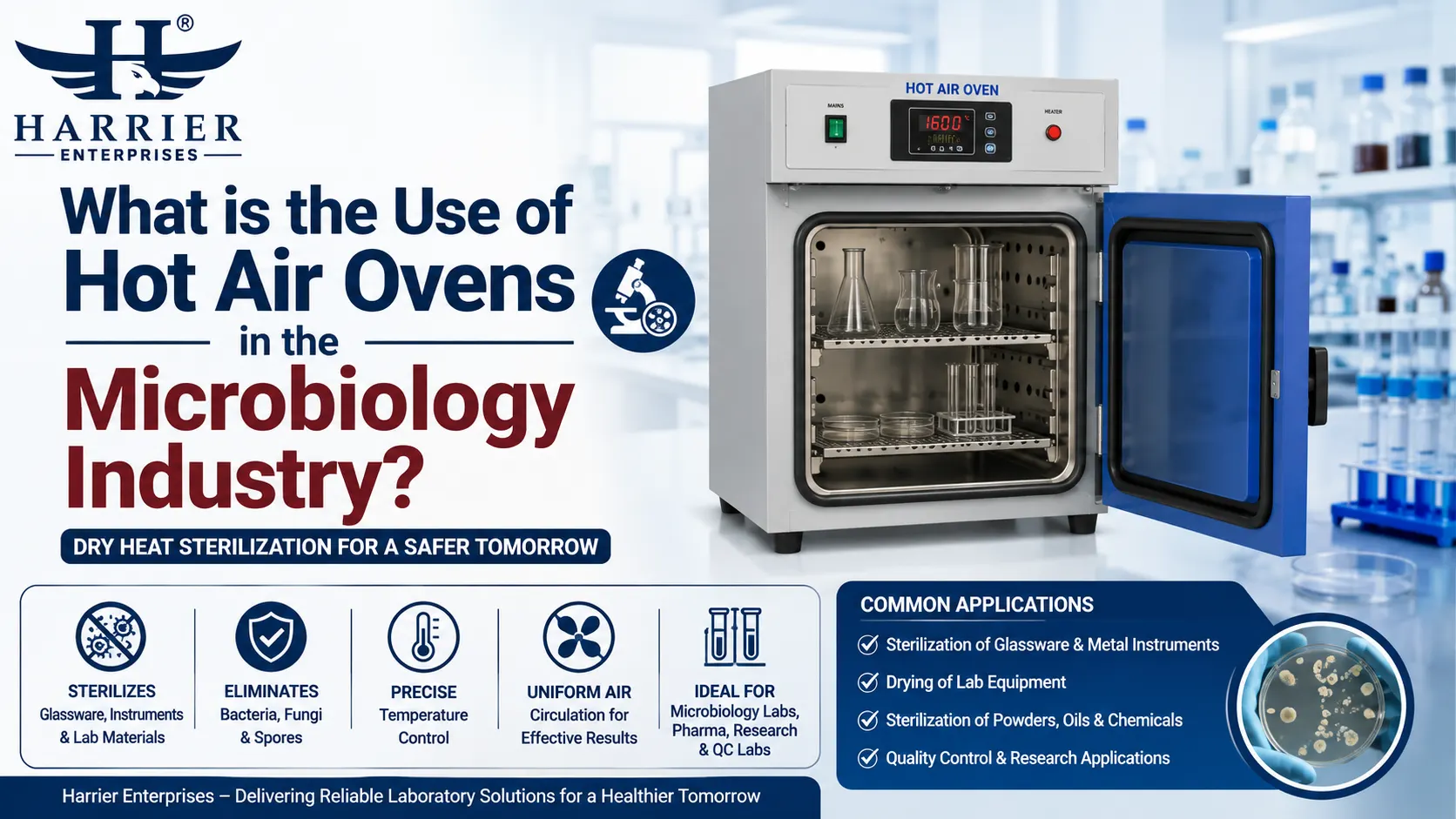
A Hot Air Oven is widely used in microbiology laboratories for dry heat sterilization of glassware, metal instruments, powders, oils, and moisture-sensitive materials. It works by circulating hot air evenly inside an insulated chamber, ensuring complete sterilization without using steam. The heating elements raise the chamber temperature, while the temperature controller maintains the desired heat level. This method destroys microorganisms by oxidation, making the equipment safe for laboratory use.
Hot Air Oven Diagram in Microbiology
               HOT AIR OVEN

    +--------------------------------------+
    |      Digital Temperature Display     |
    |        & PID Controller              |
    +--------------------------------------+
    |                                      |
    |  +------------------------------+    |
    |  |      Insulated Chamber       |    |
    |  |                              |    |
    |  |  Glassware / Instruments     |    |
    |  |  Petri Dishes / Test Tubes   |    |
    |  |  Flasks / Pipettes           |    |
    |  |                              |    |
    |  +------------------------------+    |
    |                                      |
    |   ← Hot Air Circulation Fan →        |
    |                                      |
    |  Heating Elements (Bottom/Sides)     |
    |______________________________________|
    |          Insulated Outer Body        |
    +--------------------------------------+
Parts of a Hot Air Oven
- Digital Temperature Controller – Maintains accurate heating throughout the sterilization process.
- Heating Elements – Generate dry heat inside the chamber.
- Insulated Chamber – Prevents heat loss and ensures uniform temperature distribution.
- Air Circulation Fan – Circulates hot air evenly for effective sterilization.
- Wire Mesh Shelves – Hold laboratory glassware and instruments.
- Door with Heat-Resistant Gasket – Prevents heat leakage and maintains chamber temperature.
Working Principle
- Laboratory items are placed inside the oven.
- The desired temperature (typically 160°C–180°C) is set using the digital controller.
- Heating elements produce dry heat.
- The circulation fan distributes hot air uniformly throughout the chamber.
- Microorganisms are destroyed by oxidation after the required sterilization time.
- Once the cycle is complete, the oven is allowed to cool before removing the sterilized items.
Conclusion
Hot air ovens play a vital role in the microbiology industry by providing reliable dry heat sterilization for laboratory equipment, glassware, metal instruments, powders, and other heat-resistant materials. Their ability to maintain contamination-free laboratory conditions makes them indispensable for microbiological research, quality control, and testing.
Harrier Enterprises, Laboratory Hot Air Oven Manufacturer provides high-performance hot air ovens that combine precision, durability, and energy efficiency. Our hot air ovens are designed to deliver consistent sterilization results and support safe, accurate laboratory operations.
Frequently Asked Questions (FAQs)
1. What is the primary use of a hot air oven in microbiology?
A hot air oven is used to sterilize laboratory glassware, metal instruments, powders, and moisture-sensitive materials using dry heat.
2. Why is a hot air oven preferred over an autoclave for some materials?
Hot air ovens are ideal for materials such as glassware, oils, powders, and metal instruments that may be damaged by steam or moisture.
3. Which industries use hot air ovens?
Hot air ovens are widely used in microbiology laboratories, pharmaceutical companies, biotechnology industries, hospitals, food testing laboratories, and research institutes.
4. What are the advantages of a laboratory hot air oven?
They provide uniform heating, precise temperature control, energy-efficient operation, reliable sterilization, and are suitable for moisture-sensitive materials.
5. Why choose Harrier Enterprises for hot air ovens?
Harrier Enterprises manufactures high-quality hot air ovens with advanced temperature control, uniform heat distribution, durable construction, and customizable designs to meet the needs of modern laboratories and industrial applications.